What does “We the People” mean?
The most famous words in the Constitution began as a list of states and drew an angry objection. Here is what they meant in 1787 and what they came to mean.
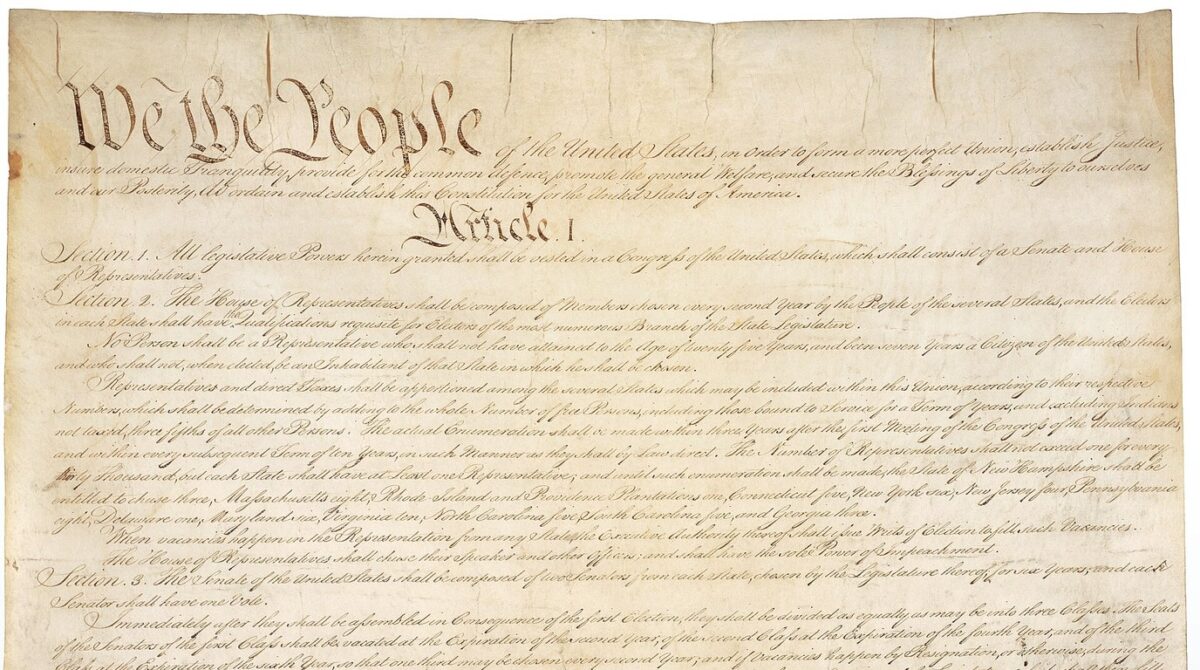
“We the People” means the Constitution claims its authority from the people of the United States, not from the state governments. The words were written in September 1787, most likely by Gouverneur Morris. At the time, most people living here could not vote, and the phrase reached further only through later amendments and laws.
Key points
- The Preamble’s first words say who is creating the Constitution: the people of the United States.
- An August 1787 draft named each of the 13 states. The Committee of Style replaced that list with “the United States.”
- Patrick Henry objected in 1788, asking who authorized the framers to say “We, the people” instead of “We, the states.”
- Enslaved people, most women and many men without property were left out in 1787. Later amendments and laws widened who counted.
In this post
- What does “We the People” mean in the Constitution?
- Who wrote “We the People”?
- Why does the Constitution start with “We the People”?
- Why “We the People” and not “We the States”?
- Who objected to “We the People”?
- Who was left out of “We the People” in 1787?
- How did “We the People” get wider?
- What does “We the People” mean today?
- This site’s own view
- Questions people ask
- Sources
What does “We the People” mean in the Constitution?
It names who is acting. The Preamble is one sentence, and its subject and verb sit far apart: “We the People of the United States … do ordain and establish this Constitution for the United States of America.” Everything in between is the list of reasons.
That makes the phrase a claim about authority. The people make the government, and the government answers to them. Law professors Erwin Chemerinsky and Michael Stokes Paulsen wrote the National Constitution Center’s shared explanation of the Preamble together, then wrote separate essays taking it in different directions. On this point they speak as one:
The Constitution is “owned” (so to speak) by the people, not by the government or any branch thereof.
Erwin Chemerinsky and Michael Stokes Paulsen, National Constitution Center, “The Preamble”
The phrase has a legal limit. The Preamble hands out no powers of its own. In Jacobson v. Massachusetts (1905), the Supreme Court said it “has never been regarded as the source of any substantive power conferred on the government of the United States.”
Who wrote “We the People”?
Gouverneur Morris of Pennsylvania most likely wrote the final wording, though it went out under a committee’s name. On September 8, 1787, the Convention chose a committee by ballot “to revise the stile of and arrange the articles which had been agreed to by the House.” Its members were Johnson, Hamilton, Morris, Madison and King. It reported on September 12.
The evidence for Morris comes largely from James Madison, who sat on that committee. In 1831, 44 years later, Madison wrote: “The finish given to the style and arrangement of the Constitution fairly belongs to the pen of Mr. Morris.” He added that the job was “probably” handed to Morris by the chairman, so even his memory hedges. The records show no debate about the new opening. As the legal scholar William Michael Treanor put it in 2021, “the Convention records do not report any discussion about the Committee of Style’s revised preamble.”
You can watch the change in the Convention’s own records:
| Date | Source | How it opened |
|---|---|---|
| Aug. 6, 1787 | Committee of Detail | “We the people of the States of New Hampshire, Massachussetts, Rhode-Island and Providence Plantations, Connecticut, New-York, New-Jersey, Pennsylvania, Delaware, Maryland, Virginia, North-Carolina, South-Carolina, and Georgia…” |
| Sept. 12, 1787 | Committee of Style | “We, the People of the United States, in order to form a more perfect union…” |
| Sept. 17, 1787 | Signed text | “We the People of the United States, in Order to form a more perfect Union…” |
Why does the Constitution start with “We the People”?
Its backers said its authority rested on the people, acting through ratifying conventions, and not on the state governments. James Wilson, a delegate from Pennsylvania, made that argument to his state’s convention in December 1787. The new government, he said, “is founded upon the power of the people.” Article VII follows through: it asks for approval by “the Conventions of nine States,” not by state legislatures.
Why “We the People” and not “We the States”?
The usual explanation is practical, and some scholars think there was more to it. Under Article VII, nine of the 13 states could put the Constitution into effect, so nobody could know who would be in. Rhode Island had not even appointed delegates. North Carolina and Rhode Island did not ratify until after Washington’s inauguration. The scholar Clinton Rossiter, as quoted by Treanor, put it this way:
Since no one could tell for certain which states would ratify and which would stall or even refuse flatly to join, the sensible course was to leave out any mention at all of New Hampshire and her twelve sisters.
Clinton Rossiter, quoted in William Michael Treanor, Michigan Law Review, 2021
Treanor disagrees. He points out that the committee could have solved the same problem with “We the People of the States of the United States.” In his reading, Morris chose wording that fit his belief in one nation over a league of states. That is one scholar’s argument from the text and from Morris’s other statements. The Convention’s records don’t give the committee’s reasons, so you get to weigh it yourself.
Who objected to “We the People”?
Anti-Federalists objected, and the sharpest was Patrick Henry, who had been appointed to the Philadelphia convention and did not attend. On June 4, 1788, he asked Virginia’s ratifying convention:
What right had they to say, We, the people? My political curiosity, exclusive of my anxious solicitude for the public welfare, leads me to ask, Who authorized them to speak the language of, We, the people, instead of, We, the states?
Patrick Henry, Virginia Ratifying Convention, June 4, 1788
The objection had force, because the delegates had been chosen by the states. Joseph Taylor told North Carolina’s convention the same thing: “We, the people, is surely an assumed power.” James Iredell answered that the words were “not to be applied to the members themselves, but was to be the style of the Constitution, when it should be ratified in their respective states.” Until the people’s conventions approved it, in other words, it was only a proposal.
The founding generation never fully settled which “people” it meant. Madison, in Federalist No. 39, said ratification would come from the people “not as individuals composing one entire nation, but as composing the distinct and independent States to which they respectively belong.” Chief Justice John Marshall, in McCulloch v. Maryland (1819), stressed the other side: “The government proceeds directly from the people.” Both men were reading the same words.
Who was left out of “We the People” in 1787?
Most people living in the country were left out of the group that could vote or hold power. The Constitution itself shows part of this. Article I counted “three fifths of all other Persons,” meaning enslaved people, and excluded “Indians not taxed.”
The numbers are stark. A table of the 1790 census in Richard Keyser’s legal history textbook lists 694,280 enslaved people out of 3,893,635 counted, about 18 percent. Free white males aged 16 and over came to 807,094, about 21 percent.
Voting was left to the states. Alexander Keyssar’s tables, reproduced in the same textbook, show 10 of the 13 states with property requirements in 1790. They list explicit “white” limits in three states (Georgia, South Carolina and Virginia) and no race limit elsewhere. Women generally could not vote, with one exception: New Jersey let some women vote until 1807, when it restricted suffrage to adult white male taxpaying citizens.
Morris himself cuts both ways. On August 7, 1787, he moved to limit voters to freeholders, meaning landowners, and lost. The next day he called slavery “a nefarious institution.”
In 1857, the Supreme Court in Dred Scott gave the narrow reading its harshest form, saying Black Americans “are not included, and were not intended to be included” among citizens. Frederick Douglass answered with the text in an 1860 speech: “Its language is ‘we the people;’ not we the white people.” Barbara Jordan, a member of Congress from Texas, described the gap in 1974:
But when that document was completed on the seventeenth of September in 1787, I was not included in that “We, the people.”
Barbara Jordan, House Judiciary Committee statement, 1974
She went on: “through the process of amendment, interpretation, and court decision, I have finally been included.”
How did “We the People” get wider?
It got wider one fight at a time, mostly through amendments. The list below is not a straight line. The National Archives notes that after the 15th Amendment, literacy tests and “grandfather clauses” were written into the laws of former Confederate states to keep Black Americans from voting.
| Year | Change | What it did |
|---|---|---|
| 1865 | 13th Amendment | Abolished slavery |
| 1868 | 14th Amendment | Citizenship for “All persons born or naturalized in the United States, and subject to the jurisdiction thereof,” overturning Dred Scott together with the 13th |
| 1870 | 15th Amendment | Barred denying the vote because of race, color or prior servitude |
| 1913 | 17th Amendment | Senators “elected by the people” of each state |
| 1920 | 19th Amendment | Barred denying the vote because of sex |
| 1924 | Indian Citizenship Act | Citizenship for Native Americans, though state law denied some the ballot until 1948 in Arizona and New Mexico and 1957 on reservations in Utah, per the AP |
| 1964 | 24th Amendment | Ended poll taxes in federal elections |
| 1965 | Voting Rights Act | Federal law against discriminatory voting practices; the Supreme Court struck down a key provision in 2013 |
| 1971 | 26th Amendment | Barred denying the vote to citizens 18 and older because of age |
What does “We the People” mean today?
Legally it means what it did in 1905: it declares who enacted the Constitution and grants nothing on its own. Beyond that, people disagree in good faith. In their separate essays, Chemerinsky argues the Preamble states basic values that should guide how courts read the whole document, including the national government’s authority to act. Paulsen argues it gives only “a very gentle interpretive ‘push’” and that where the text sets no rule, decisions “must remain open to the people, acting through the institutions of representative democracy.” Both claim to be taking the words seriously. For what surveys find about agreement and disagreement now, see what Democrats and Republicans agree on.
This site’s own view
What follows is our opinion, not history. The framers wrote in the plural, and for a long time the plural was narrower than it sounded. We think the phrase asks something of one person at a time: a conviction you will say in the first person and test with someone who disagrees, in the spirit of civil discourse. I’m The People isn’t open yet. When it is, it would introduce you to one person who places themselves somewhere else, for a private conversation. A historian could fairly say that’s a stretch of what Morris meant, and we’d accept the criticism.
Questions people ask
What does we the people mean?
It means the Constitution claims its authority from the people of the United States rather than from the state governments. The phrase opens the Preamble and names who is enacting the document.
What does we the people mean in the Constitution?
It is the subject of the Preamble’s one sentence, which says the people “do ordain and establish this Constitution.” It grants no powers itself. The Supreme Court said so in Jacobson v. Massachusetts in 1905.
What does we the people mean today?
Legally, it still declares who enacted the Constitution. Scholars disagree about how much it should guide interpretation. Chemerinsky argues it states values that should guide courts, while Paulsen sees only a very gentle interpretive push.
Who wrote we the people?
Gouverneur Morris most likely wrote the final wording as a member of the Committee of Style. The main evidence is an 1831 letter from James Madison, and the Convention’s records report no discussion of the change.
Why does the Constitution start with we the people?
Its backers said its authority rested on the people, acting through ratifying conventions. James Wilson told Pennsylvania’s convention in 1787 that the government was founded upon the power of the people.
Why we the people and not we the states?
An August 1787 draft listed all 13 states, but only nine had to ratify, so no one knew who would join. William Michael Treanor argues Gouverneur Morris also intended a national vision. Patrick Henry attacked the wording in 1788.
Sources
- National Archives, The Constitution of the United States: A Transcription
- National Archives, The Constitution: Amendments 11 to 27
- James Madison, Notes of Debates, August 6, 1787, Avalon Project, Yale Law School
- James Madison, Notes of Debates, September 8, 1787, Avalon Project, Yale Law School
- Records of the Federal Convention (Preamble drafts), The Founders’ Constitution, University of Chicago Press
- Patrick Henry (1788), Virginia Ratifying Convention, The Founders’ Constitution, University of Chicago Press
- Debate in North Carolina Ratifying Convention (1788), The Founders’ Constitution, University of Chicago Press
- William Michael Treanor (2021), The Case of the Dishonest Scrivener, Michigan Law Review
- James Madison (1831), Letter to Jared Sparks, Constitution Society
- Erwin Chemerinsky and Michael Stokes Paulsen, The Preamble, National Constitution Center
- Alexander Keyssar, Suffrage Requirements tables, in Richard Keyser (2020), American Legal History to the 1860s
- National Archives, Dred Scott v. Sandford (1857)
How this was written. Compiled with AI assistance and checked against the sources listed above. Polls and studies report what they found at the time, and they are not I’m The People’s findings. We have none yet. We are not a party, a candidate or a side. If you spot an error, tell us and we will fix it.