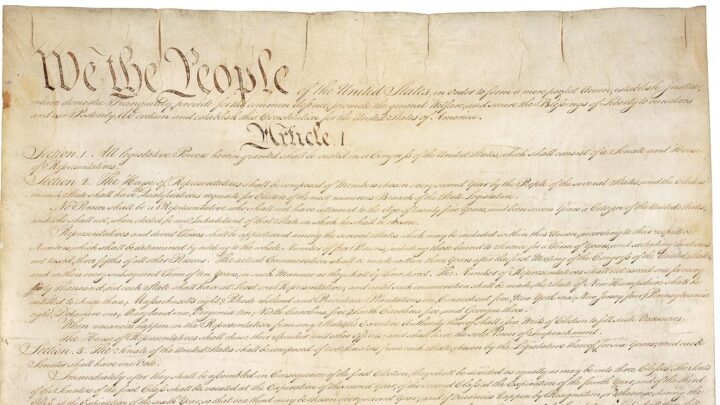
What does “We the People” mean?
The most famous words in the Constitution began as a list of states and drew an angry objection. Here is what they meant in 1787 and what they came to mean.
You don’t change government from the top down. I’m The People shows you where the people who represent you actually stand, next to where you stand, vote by vote, with the receipts. Then it puts you in the room with people who see it differently, to find what you can sign together.
Opening soon. We start with Congress; state legislatures, city councils, counties and school boards follow, city by city.
Twelve issues, each between two real choices, never left or right. About ten minutes. Your answers stay private; other members see only the label you choose for yourself.
Enter your address once. We use it to find your districts, then throw it away. You see everyone who represents you, starting closest to home.
See how often each one votes your way and how their record lines up with your values, every number linked to the vote behind it. A weekly email, the Pulse, tells you what they did.
Talk it through with people who see it differently, where a comment rises only when both sides find it useful. What a district agrees on goes to its officials, signed across the spectrum.
We start with Congress: your U.S. representative and both senators. State legislatures, city councils, counties and school boards follow, city by city, beginning in Salt Lake County.
Votes your way puts your position on a measure next to how your official actually voted. Nothing to interpret, so nothing to spin.
Values fit compares your values interview with their record, using only votes a person has reviewed, and it always shows how much evidence it rests on.
Every row links to the public record it came from. Where a vote is still coming up, you can take your position first, and see afterward whether they voted your way.
Discussion about what your officials are doing, open to every member. Everyone’s lean shows, in the words they chose for themselves.
A comment only rises when people on both sides mark it useful, so piling on from one side does nothing. Each thread shows its Common Ground Meter, and each side’s best case: the comment the other side found most useful.
When two people from opposite sides keep finding each other useful, they get a quiet invitation to talk one on one.
When people in a district find something they can all sign, they put it in a statement. Its headline is never just the count. It is who signed, by lean.
Then it goes to the officials for that district, as a letter that names no one. A position held across the spectrum by the people they represent is hard to wave away.
Some of the best agreement happens two people at a time. In a private conversation, when you find a sentence you both believe, you write it down. It counts only once you both confirm it, and then it joins the public Common Ground page, with your two leanings and without your names.
There is no official list to start from. The page starts empty on purpose. People fill it in.
The first sentence has not been written.
Confirmed by both. No names. Either of you can take it back.
No software is going to tell you what the country agrees on, or what a vote really meant. Those calls belong to people.
At opening, nothing on the site uses AI. If it is switched on later, it may only suggest which issues a bill touches, for a person to approve, and summarize public discussions in members’ own words. Private conversations never go to it, and this site will say so before it happens.
Look closely at our mark. Every figure in it is one person. The I is made of the people who stood up, and the gold one at its base is you, where bottom-up starts.
Nobody here speaks for a side. You speak for yourself, and so does everyone you meet.
The most famous words in the Constitution began as a list of states and drew an angry objection. Here is what they meant in 1787 and what they came to mean.
No endorsements are coming. The unit here is one person, which is the whole argument.
There is no list to climb and no crowd to be counted in. You belong to your own district, and you speak for yourself.
There is no ask. It costs nothing to see where your officials stand.
I’m The People is a non-partisan civic project, a reverse echo chamber for politics. It shows you where the people who represent you stand next to where you stand, vote by vote with the public record behind every number, and puts you in discussion with people who see things differently, where only what both sides find useful rises. What a district agrees on goes to its officials, signed across the spectrum. People decide; the software keeps the record.
At opening, your members of Congress: your U.S. representative and both of your senators. State legislatures, city councils, counties and school boards follow, city by city, starting in Salt Lake County.
Two ways. Votes your way puts your position on a measure next to your official’s actual vote, nothing more. Values fit compares your values interview with their record, using only votes a person has reviewed, and shows how much evidence it rests on. Every number links to the public record behind it.
No. It is used once, with the U.S. Census Bureau’s public lookup, to find your districts, and then it is thrown away. We keep only the districts.
It is our name for the opposite of a feed that surrounds you with people who agree with you. Instead, you are put in front of people who see things differently: in discussions where only what both sides find useful rises, and one on one. The term is our own description, not a scientific one.
No. There is no party, no candidate, no side and no list to join. The unit is one person speaking for themselves.
No. At opening, nothing on the site uses AI: introductions and rankings follow plain rules, and a person reviews what every vote means. If AI is switched on later, it may only suggest, for a person to approve, and summarize public discussions in members’ own words. Private conversations never go to it.
We are opening soon. Leave your email and we will let you know.
Priya N. Libertarian Bridges the divide
Property rights cut both ways here. If I own the lot, I should be able to build. If you own the lot next door, you deserve a real say on drainage and height. Both can be true.
Useful to 2 left, 1 center, 2 right